
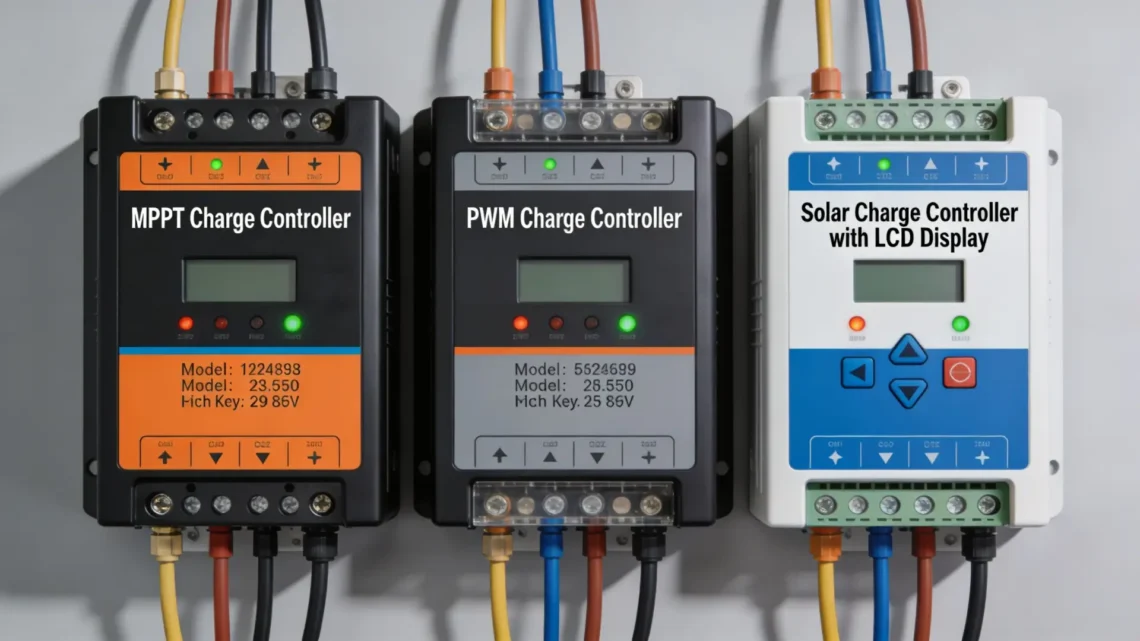
So, you’re wondering about PWM vs. MPPT charge controllers and what the big deal is? The quick answer is this: MPPT controllers are generally more efficient, especially in certain conditions, because they can extract more power from your solar panels. PWM controllers are simpler and cheaper, good for smaller, less demanding systems where efficiency isn’t the absolute top priority. We’ll dive into why this is the case and help you figure out which one makes sense for your setup.
Table of Contents
The Charge Controller Basics
Before we get into the nitty-gritty of PWM and MPPT, let’s briefly touch on why we even need a charge controller in the first place. Think of it as the brain of your solar charging system. Its main job is to regulate the voltage and current coming from your solar panels before it reaches your batteries. Without one, you’d risk overcharging or over-discharging your batteries, significantly shortening their lifespan or even damaging them.
Furthermore, solar panels don’t always produce a consistent voltage. Environmental factors like temperature and sunlight intensity can cause fluctuations. A charge controller ensures that your batteries receive a stable and appropriate charge, protecting your investment in both panels and batteries. It also often includes features like reverse current protection (stopping power from flowing back to the panels at night) and load control.
When considering solar power systems for your RV, understanding the differences between PWM (Pulse Width Modulation) and MPPT (Maximum Power Point Tracking) charge controllers is crucial for optimizing energy efficiency. For a simple explanation of these two types of charge controllers and their benefits, you can refer to this informative article. Additionally, if you’re planning your first RV trip, it’s essential to be well-prepared; check out this helpful first RV trip checklist to ensure you have everything you need for a successful adventure.
PWM: The Simple, Reliable Workhorse
Pulse Width Modulation (PWM) charge controllers are the older, more established technology. They’re straightforward, effective for many applications, and generally come with a lower price tag.
How PWM Works
Imagine your solar panel producing a certain voltage, say 18 volts, while your 12-volt battery needs to be charged. A PWM controller basically acts like a smart switch. When your battery needs charging, it rapidly connects and disconnects the solar panel to the battery. It does this really, really fast – thousands of times per second.
The “pulse width” refers to how long the connection stays “on” versus “off” in each cycle. If your battery is low, the “on” time (the pulse width) will be longer, allowing more current to flow. As your battery gets closer to full, the controller shortens the “on” time, reducing the current and preventing overcharging. This process essentially “chops” the panel’s voltage down to match the battery voltage.
Key Characteristics of PWM
Understanding these characteristics will help you see where PWM shines and where it might fall short.
Voltage Matching
One of the most important things to grasp about PWM is that it forces the solar panel to operate at a voltage very close to that of the battery. If your solar panel has a maximum power point voltage (Vmp) of, say, 18V, and your 12V battery is currently at 13V, the PWM controller will essentially pull the panel’s operating voltage down to 13V. This means you’re not utilizing the panel’s full power potential. The “lost” voltage is dissipated as heat or simply not extracted from the panel.
Efficiency Considerations
Because PWM controllers bring the solar panel’s voltage down to the battery’s voltage, they’re not always the most efficient choice, especially if there’s a significant difference between the panel’s Vmp and the battery’s voltage. For instance, if you have a “12V” panel (which often has a Vmp of around 17-18V) and a 12V battery, a good portion of the panel’s potential voltage is unused.
However, if your panel’s Vmp is very close to your battery’s charging voltage (e.g., an 18V panel charging a 12V battery that is nearly full at 14.4V), the efficiency can be quite good. The “lost” power mainly comes from the voltage difference rather than the current.
Cost-Effectiveness
PWM controllers are significantly less complex internally than MPPT controllers. This simpler design translates directly into lower manufacturing costs, making them a much more budget-friendly option upfront. For small systems, such as those powering a single light or a fan, the cost savings often outweigh the minor efficiency loss.
Simplicity and Reliability
These controllers have fewer electronic components, which generally means there’s less that can go wrong. Their design is robust and they tend to be very reliable. Installation is also typically straightforward, often just connecting the panel, battery, and possibly a load.
Temperature Sensitivity
PWM efficiency can be more sensitive to temperature variations. Solar panels’ voltage output changes with temperature. While PWM controllers regulate charging, they don’t actively adapt to these changes as efficiently as MPPT controllers do to maximize power extraction across varying temperatures.
When PWM Makes Sense
PWM controllers are an excellent choice in several scenarios, particularly for smaller and less demanding applications.
Small Systems
For cabins, RVs, boats, or off-grid sheds that only need to power a few lights, charge phones, or run a small fan, a PWM controller is often perfectly adequate. The efficiency gains from an MPPT controller might not justify the extra cost in these cases.
Matching Voltages
If your solar panel’s open-circuit voltage (Voc) and Vmp are relatively close to your battery bank’s voltage (e.g., a “12V” solar panel with a Vmp of around 17-18V charging a 12V battery bank), the efficiency loss of a PWM controller is minimized. In these situations, the difference in power extracted might be negligible enough that the cost saving of a PWM controller is the better economic choice.
Budget Constraints
When budget is a primary concern, PWM controllers offer a very effective solution for their price. They provide essential battery protection and charging functionality without breaking the bank.
Short-Term or Infrequent Use
For applications where the solar system isn’t running constantly or isn’t critical (like a weekend camper setup), the slightly lower efficiency of a PWM controller isn’t likely to have a significant impact on overall performance or user experience.
MPPT: The Smart Power Harvester
Maximum Power Point Tracking (MPPT) charge controllers are the more advanced, higher-efficiency option. They’re designed to maximize the power harvest from your solar panels, especially under varying conditions.
How MPPT Works
Unlike PWM controllers that just chop the voltage, MPPT controllers are much more sophisticated. They act as a DC-to-DC converter. They constantly monitor both the voltage and current output of your solar panel and compare it to the battery voltage. They then use a complex algorithm to continuously find the “maximum power point” of the solar panel.
The “maximum power point” is the optimal combination of voltage and current at which a solar panel produces its highest power output. This point isn’t fixed; it changes throughout the day based on sunlight intensity, temperature, and panel shading.
Once the MPPT controller finds this optimal point, it essentially converts the panel’s higher voltage (e.g., 30V from a “24V” panel) down to the battery’s voltage (e.g., 14.4V for a 12V battery). But here’s the clever part: it does this conversion in a way that conserves power. If it has to drop the voltage, it will increase the current proportionally, so the overall power (Volts x Amps) delivered to the battery remains as high as possible.
Think of it like this: a high-pressure, low-flow water hose (high voltage, low current) is converted into a lower-pressure, high-flow hose (lower voltage, higher current), but the total amount of water (power) coming out stays the same, or at least very close to the original amount.
Key Characteristics of MPPT
MPPT controllers have distinct advantages and some trade-offs compared to PWM.
Superior Efficiency
This is the main selling point. MPPT controllers can achieve efficiencies of 92% to 98% in converting the panel’s power to the battery’s charging power. This means they capture significantly more energy, especially when the panel’s voltage is much higher than the battery’s voltage, or in challenging environmental conditions.
Voltage Step-Down Capability
MPPT controllers are essentially intelligent DC-to-DC converters. They can efficiently take a high voltage input from solar panels (e.g., 60V or 100V) and step it down to the appropriate battery charging voltage (e.g., 12V, 24V, or 48V). This allows for greater flexibility in system design, letting you use high-voltage panels, which are often more readily available and efficient for longer wire runs, with any battery bank.
Benefits in Cold & Cloudy Weather
Solar panels produce higher voltage in colder temperatures. An MPPT controller can take advantage of this increased voltage to output more power to your battery. Similarly, in cloudy or low-light conditions, where overall power output is lower, the MPPT’s ability to constantly track the maximum power point ensures that even the diminished power available is fully utilized. PWM controllers simply pull the voltage down, potentially losing a larger percentage of the already scarce power.
Higher Cost
The advanced electronics and complex algorithms required for MPPT functionality mean they are considerably more expensive than PWM controllers. The price difference can be significant, sometimes two to three times the cost of a comparable PWM unit.
More Complex Internal Design
With more components and sophisticated programming, MPPT controllers are inherently more complex. While modern MPPT units are highly reliable, this complexity means there are more potential points of failure compared to the simpler PWM design. Their internal fans (in larger units) also add another moving part that could eventually fail.
System Sizing Flexibility
MPPT controllers allow for much greater flexibility in pairing solar panels with battery banks. You can use panels designed for grid-tie systems (which often have much higher voltages) with a 12V or 24V off-grid battery bank. This can simplify wiring (higher voltage means lower current, allowing for thinner wires and less voltage drop over long distances) and sometimes allows you to find panels more easily or at better prices.
When MPPT Makes Sense
While more expensive, the benefits of MPPT controllers often justify the investment in larger or more critical solar systems.
Large Systems
For larger off-grid homes, substantial RV setups, or grid-tied systems with battery backup, the efficiency gains of an MPPT controller become substantial. The extra power harvested each day quickly adds up, potentially reducing the number of panels needed or extending battery autonomy.
Mismatched Voltages
If your solar panels have a significantly higher voltage than your battery bank (e.g., a “24V” or “48V” panel array charging a 12V battery), an MPPT controller is almost a requirement. A PWM controller in this scenario would simply waste a massive amount of the panel’s voltage, rendering much of its capacity useless. MPPT efficiently converts this higher voltage down, maximizing power delivery.
Cold Climates
As mentioned, solar panels output higher voltage in cold weather. An MPPT controller can capture this extra voltage, delivering more power to your batteries than a PWM controller would. So, if you’re in an area with consistently lower temperatures, MPPT offers a distinct advantage.
Long Wire Runs
When you have long distances between your solar panels and your charge controller/batteries, running higher voltage from the panels (which MPPT allows for) significantly reduces voltage drop and power loss in the wires. This means you can use thinner, less expensive wiring.
Critical Applications
For applications where every watt-hour counts, such as medical devices in an off-grid cabin or ensuring continuous power for essential equipment, the superior power harvesting of an MPPT controller provides a vital advantage.
Making Your Choice: PWM or MPPT?
Deciding between a PWM and MPPT controller boils down to a few key considerations about your specific solar setup and priorities. There’s no one-size-fits-all answer, so let’s break down the decision-making process.
Budget vs. Efficiency
This is often the first hurdle. PWM controllers are cheaper upfront. If you’re building a small, simple system and every dollar counts, a PWM might be the way to go, especially if the efficiency loss isn’t critical for your needs. However, for larger systems or long-term investments, the extra cost of an MPPT can often be recuperated through increased energy harvesting, which might mean you need fewer panels or your batteries last longer.
Consider the “return on investment.” How many more watt-hours per day will an MPPT controller provide for your specific setup, and how much is that worth to you over the lifetime of the system?
System Size and Complexity
For very small systems, like a single 100W panel charging a 12V battery for a basic shed light, a PWM controller is usually sufficient. The absolute amount of power lost due to inefficiency is so small that the extra cost of an MPPT isn’t justified.
As your system grows, adding more panels, larger battery banks, or higher power demands, the cumulative efficiency gains of an MPPT controller become much more significant. For systems over 200-300W, or especially 500W and above, an MPPT controller usually makes economic and performance sense.
Panel and Battery Voltage Matching
This is a critical factor.
- If your panel’s Vmp is very close to your battery’s charging voltage, a PWM controller can be surprisingly efficient. This often happens with “12V” panels directly charging a 12V battery, especially when the battery is near full.
- If your panel’s Vmp is significantly higher than your battery’s charging voltage (e.g., a 60-cell, 250W+ panel meant for grid-tie systems, which often output 30-38V Vmp, charging a 12V battery), an MPPT controller is almost mandatory. A PWM controller would waste a huge portion of that panel’s potential energy. This is a common scenario in modern off-grid systems as grid-tie panels are economical and widely available.
Environmental Conditions
- Cold Climates: If you’re in an area with cold temperatures (which cause panels to produce higher voltage), an MPPT controller will capture that increased voltage and convert it into usable power for your batteries.
- Shading/Partial Cloudiness: While neither controller completely solves the issue of heavy shading, MPPT controllers are generally better at adapting to rapidly changing irradiance levels and maintaining optimal power extraction even when conditions are less than ideal.
Future Expandability
If you plan to expand your solar system in the future, investing in an MPPT controller upfront can offer greater flexibility. You might start with a 12V battery bank but later add more panels in series to increase voltage, or choose more efficient higher-voltage panels. An MPPT controller will handle these changes much better than a PWM could.
When exploring the differences between PWM and MPPT charge controllers, it’s essential to understand how each technology impacts solar energy efficiency. PWM, or Pulse Width Modulation, is a simpler and more cost-effective option, while MPPT, or Maximum Power Point Tracking, offers advanced capabilities that can significantly enhance energy capture from solar panels. For a deeper dive into this topic, you can read a related article that discusses the advantages and disadvantages of both systems. This will help you make an informed decision based on your specific needs. To learn more, visit this informative article.
Don’t Forget the Cables!
Often overlooked, the cabling connecting your solar panels to your charge controller and then to your battery is crucial. This applies to both PWM and MPPT systems.
Voltage Drop
Voltage drop occurs when the electrical resistance of the wires converts some of the electrical energy into heat instead of delivering it to your components. The longer the wire run and the smaller the wire gauge (thinner wire), the greater the voltage drop.
Impact on PWM
With PWM controllers, you’re already limited by forcing the panel’s voltage down to the battery’s voltage. If you then also have significant voltage drop in your wiring, your efficiency will suffer even more directly. Since PWM systems often deal with lower voltages from panels (e.g., single 12V panels), it’s crucial to correctly size the wires to minimize this loss.
Impact on MPPT
MPPT controllers often allow you to wire your solar panels in series, increasing the voltage coming from the array. Higher voltage means lower current for the same amount of power. Lower current results in less voltage drop over the same distance and wire gauge. This is a big advantage for MPPT systems, as it allows for longer wire runs or the use of slightly thinner (and thus cheaper) wiring without significant losses.
Wire Sizing Calculation
Always use a wire sizing calculator or refer to charts to ensure your cable gauge is appropriate for the length of your run and the current your panels will produce. Undersized wires mean wasted energy, reduced performance, and potentially a fire hazard. Don’t skimp on wire quality or gauge!
Conclusion: It’s All About Your Needs
Ultimately, the best charge controller for you depends entirely on your specific circumstances.
- For small, budget-conscious systems where efficiency isn’t the absolute top priority and panel voltage closely matches battery voltage, a PWM controller is a reliable and cost-effective choice. Think small RVs, basic lighting, or occasional use.
- For larger systems, critical applications, or when maximum energy harvest is key, especially with higher voltage panels or in cold climates, an MPPT controller is the superior option. The higher upfront cost is usually offset by significant gains in efficiency, flexibility, and often, a quicker return on investment over the system’s lifespan.
Take the time to evaluate your system’s size, budget, environmental factors, and future plans. Don’t just pick the cheapest or the most expensive; pick the one that makes the most sense for your unique solar journey.
FAQs
What is a PWM charge controller?
A PWM (Pulse Width Modulation) charge controller is a type of charge controller that regulates the flow of energy from solar panels to the battery by rapidly switching the power on and off.
What is an MPPT charge controller?
An MPPT (Maximum Power Point Tracking) charge controller is a type of charge controller that optimizes the energy harvest from solar panels by continuously adjusting the operating point to ensure maximum power output.
What are the main differences between PWM and MPPT charge controllers?
The main differences between PWM and MPPT charge controllers are their efficiency and cost. MPPT controllers are more efficient and can harvest up to 30% more energy compared to PWM controllers, but they are also more expensive.
When should I use a PWM charge controller?
PWM charge controllers are suitable for small-scale solar systems with a limited budget, where the energy loss due to lower efficiency is acceptable.
When should I use an MPPT charge controller?
MPPT charge controllers are recommended for larger solar systems where maximizing energy harvest is crucial, and the higher initial cost can be justified by the increased efficiency and energy savings over time.