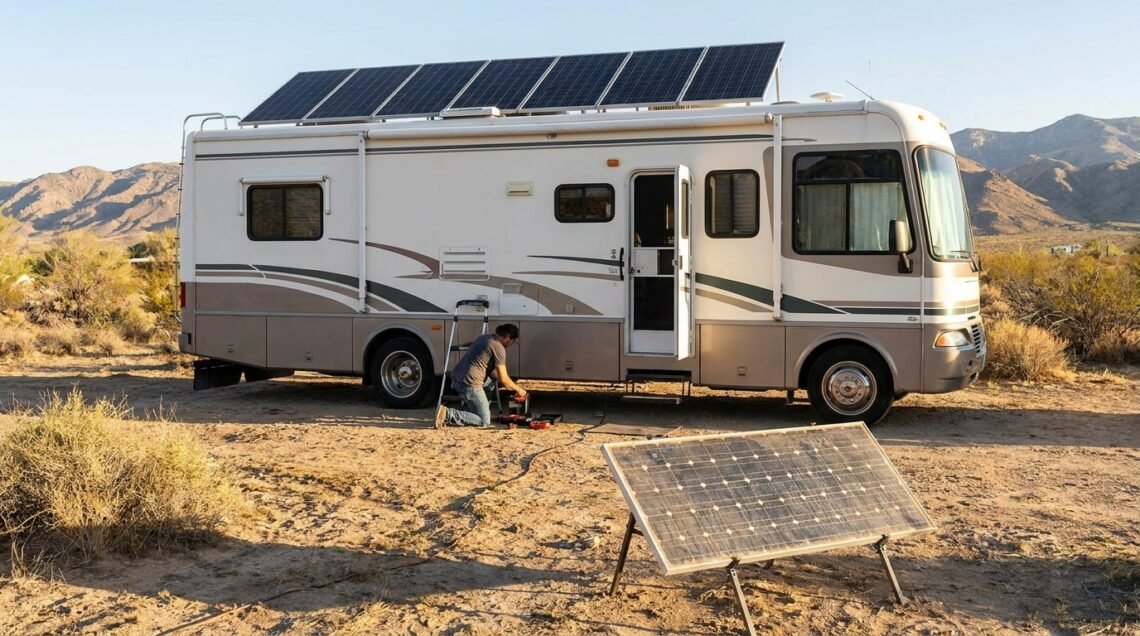
Yes, you absolutely can run AC on RV solar, but it’s not simply a matter of plugging it in. It requires a well-designed and sufficiently powerful solar system, especially if you want to run it for any significant amount of time. Think of it less like a simple flick of a switch and more like a carefully orchestrated performance that needs the right cast and crew.
Let’s start with the heart of the matter: how much power does your air conditioner actually consume? This is the primary hurdle in getting it to run reliably on solar.
Table of Contents
Varied AC Power Consumption
Not all RV AC units are created equal when it comes to power draw. A smaller 8,000 BTU unit will sip power compared to a larger 15,000 BTU model that will gulp it.
Starting vs. Running Watts
This is a crucial distinction. When an AC unit first kicks on, the compressor demands a massive surge of power – this is your “starting watts” or “surge watts.” Once it’s running smoothly, it settles into its “running watts.” Your inverter and battery bank need to be able to handle that initial surge, not just the continuous draw.
- Example: A 13,500 BTU AC unit might have running watts of 1,500W but surge watts of 3,000W or even higher. It’s essential to check your specific unit’s specifications.
Factors Affecting AC Usage
Your AC won’t always run at full tilt. External temperature, insulation, and even how often you open the door will influence how hard your AC has to work and for how long.
If you’re considering running an air conditioning unit on your RV solar system, it’s essential to understand the power requirements and setup involved. For those planning their first RV trip and looking to optimize their energy usage, you might find it helpful to check out this related article on essential preparations: First RV Trip Checklist. This guide provides valuable insights into what to pack and how to ensure a smooth journey, including tips on managing your RV’s energy consumption effectively.
The Core Components of an RV Solar System for AC
To accomplish this feat, you need more than just a few solar panels. It’s an integrated system, and each part plays a vital role.
Solar Panels: Your Energy Harvesters
These are the obvious starting point. More panels mean more potential energy generation.
- Panel Type: Monocrystalline panels are generally more efficient and perform better in low light conditions, which is a good idea for RV use where space is at a premium.
- Wattage: Focus on the total wattage. Running an AC typically requires a substantial array, often upwards of 600W to 1,000W, or even more, just to keep up with daily usage.
- Shading Considerations: Even partial shading can significantly reduce the output of an entire string of panels. Series wiring is more susceptible to this than parallel wiring.
Battery Bank: Your Energy Reservoir
This is arguably the most critical component. Solar panels generate power during the day, but your AC needs to run whenever, including cloudy days or throughout the night. Your battery bank stores that energy.
- Lithium Iron Phosphate (LiFePO4) Batteries: If you’re serious about running AC on solar, LiFePO4 batteries are the gold standard. They offer several advantages over traditional lead-acid batteries:
- Higher Usable Capacity: You can safely discharge LiFePO4 batteries much deeper (80-100%) without damaging them, compared to lead-acid (around 50%). This means a 200Ah LiFePO4 battery provides roughly the same usable energy as a 400Ah lead-acid battery.
- Faster Charging: They accept a higher charge current, meaning they can replenish faster from solar, shore power, or your alternator.
- Longer Lifespan: While more expensive upfront, their cycle life is significantly longer, often paying for themselves over time.
- Lighter Weight: A considerable advantage in an RV where weight is always a concern.
- Amp-Hours (Ah): This is the capacity measure. To run an AC for several hours, you’re looking at a substantial battery bank, often 200Ah, 400Ah, or even 600Ah or more, especially for overnight use.
Inverter: Converting DC to AC
Your solar panels and batteries produce DC (direct current) power. Your AC unit, like most household appliances, runs on AC (alternating current) power. The inverter does this crucial conversion.
- Pure Sine Wave Inverter: This is non-negotiable for sensitive electronics like your AC. Modified sine wave inverters can damage appliances and run them inefficiently.
- Wattage Rating: The inverter’s continuous wattage rating must be higher than your AC unit’s running watts. More importantly, its “surge rating” needs to handle that initial start-up spike.
- Efficiency: A good inverter will be 90-95% efficient, meaning a small amount of power is lost during conversion.
Charge Controller: Protecting Your Batteries
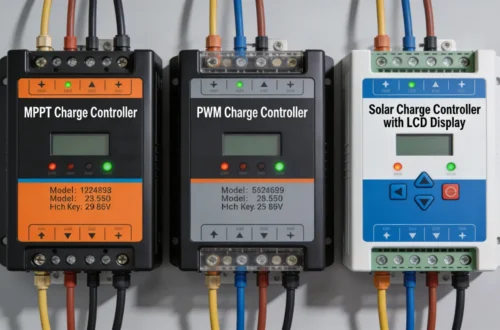
This device sits between your solar panels and your batteries. Its job is to regulate the voltage and current coming from the panels to prevent overcharging and maximize charging efficiency.
- MPPT (Maximum Power Point Tracking) vs. PWM (Pulse Width Modulation):
- MPPT: Highly recommended for larger systems, especially when running AC. MPPT controllers are significantly more efficient (10-30% more power harvest) because they can adjust their input to perfectly match the solar panel’s optimal power output, even in varying conditions.
- PWM: Less expensive and simpler, but much less efficient, especially with higher voltage panels. Not suitable for AC demands.
Wiring and Fusing: Safety and Efficiency
Undersized wiring can lead to voltage drop and a fire hazard. Proper fusing protects your components and your rig.
- Wire Gauge: Always use appropriately sized wire for the current draw and distance. Consult an AWG chart for DC wiring.
- Fuses/Breakers: Install fuses or circuit breakers at each stage of your system to protect against overcurrent.
Realistic Expectations for Running RV AC on Solar
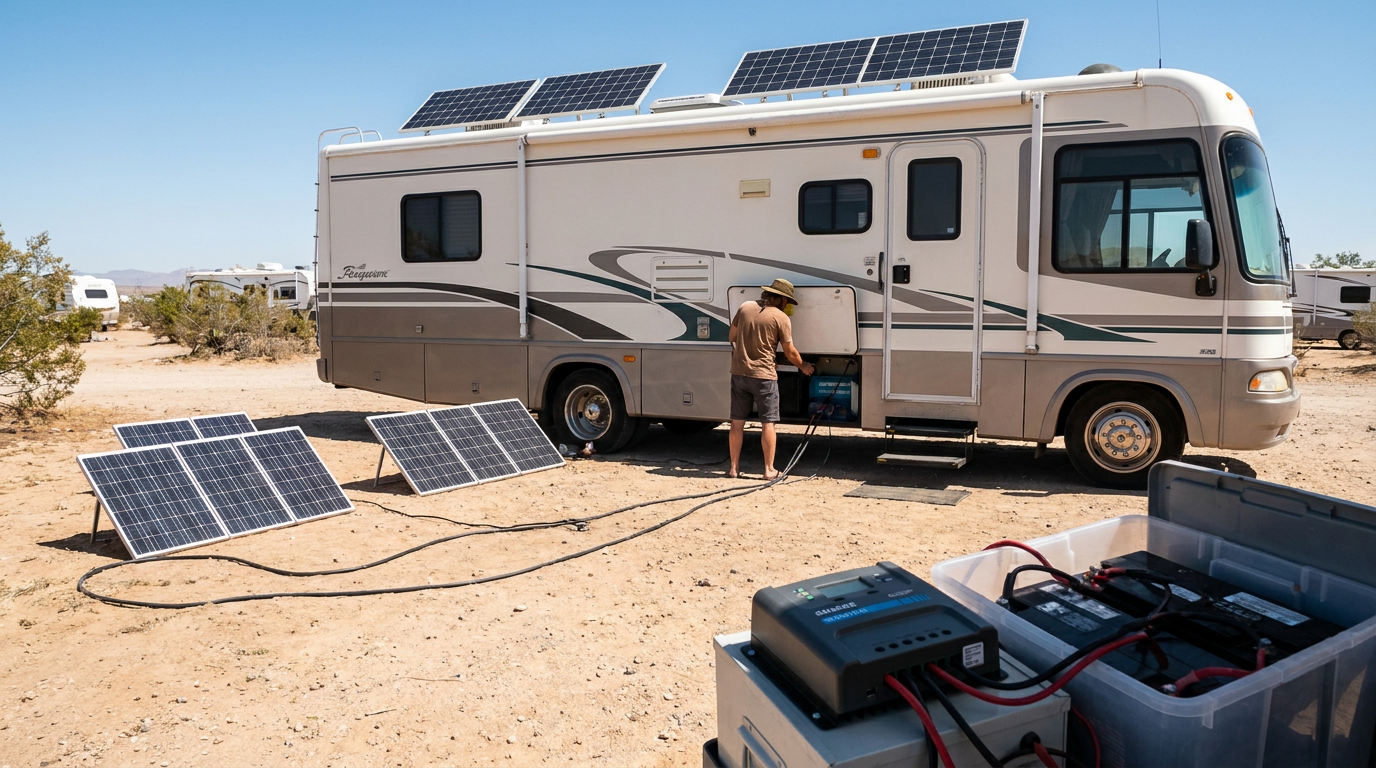
It’s tempting to think you can simply slap on a few panels and blast the AC all day. The reality is a bit more nuanced.
Sunshine is Key
Your solar panels depend on direct sunlight. Cloudy days, partial shade from trees, or facing your panels away from the sun will drastically reduce output. In these conditions, your batteries will drain much faster.
Runtime Limitations
Even with a robust system, continuous all-day, all-night AC usage from solar alone is challenging unless you have a truly massive (and expensive) setup. Most RVers aim for intermittent use – cooling down the rig after being out, or for a few hours in the afternoon.
Balancing Power Consumption
Running the AC means other power-hungry appliances will have to wait or be used sparingly. Microwaves, coffeemakers, and hair dryers are all significant draws that need to be considered.
Cost vs. Benefit
Building a solar system capable of running AC reliably is a significant investment. You need to weigh the cost of components against how often you’ll truly use it and the alternatives (like generators or shore power).
Designing Your RV Solar System for AC
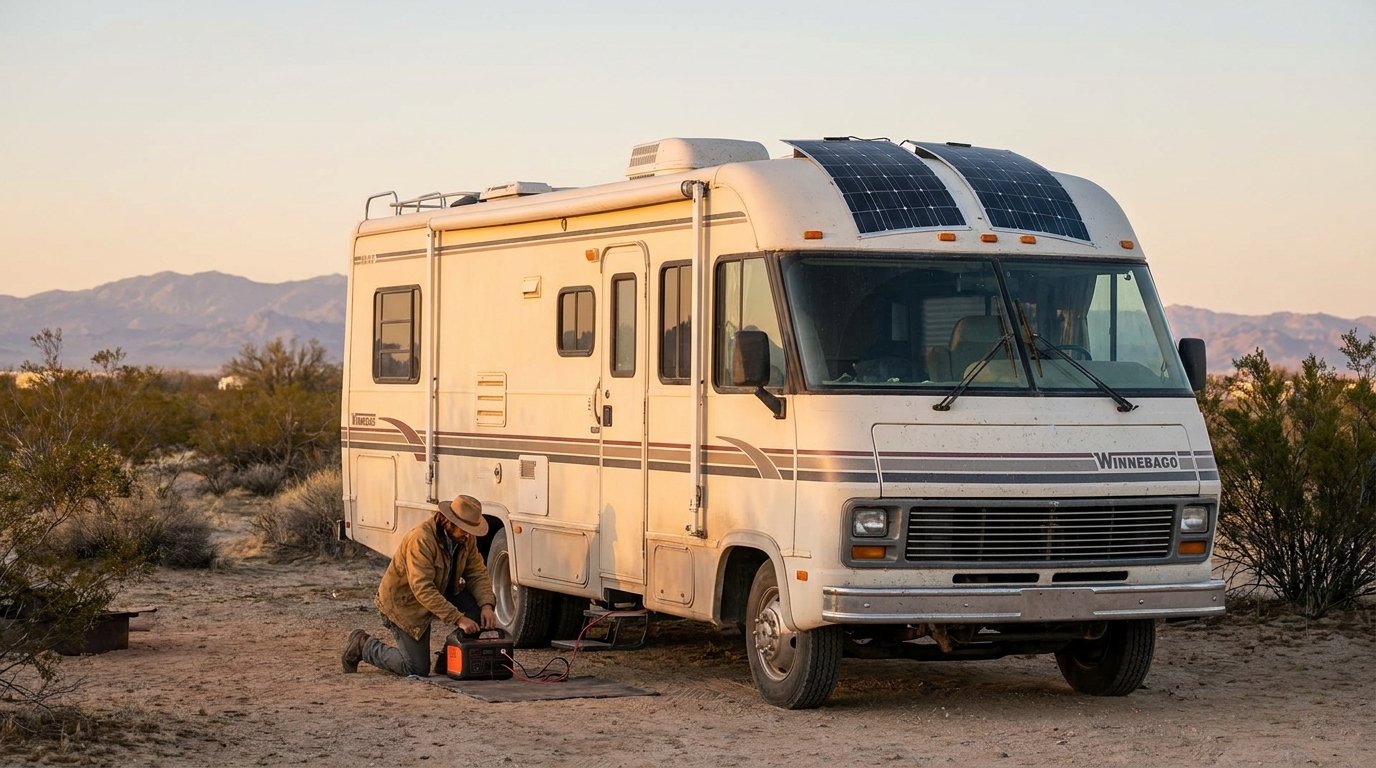
Now that you understand the components, let’s look at how to put it all together.
Step 1: Calculate Your AC’s Power Consumption
Start with your specific AC unit. Find its running watts and surge watts. Let’s assume a 1,500W running and 3,000W surge for a 13,500 BTU unit as a common example.
Step 2: Determine Your Desired AC Runtime
How many hours a day do you realistically want to run the AC?
- Example: 4 hours during the day, 2 hours in the evening. Total = 6 hours.
Step 3: Calculate Your Daily Energy Needs for AC
- Energy (Watt-hours) = Watts x Hours
- Example: 1,500W x 6 hours = 9,000 Wh per day.
Now factor in inverter inefficiency (let’s say 90%):
- 9,000 Wh / 0.90 = 10,000 Wh (from battery side)
Step 4: Size Your Battery Bank
Since we’re using LiFePO4, we can assume 80% usable capacity.
- Battery Capacity (Ah) = (Daily Wh Needed / Battery Voltage) / Usable Capacity
- Assuming a 12V system: (10,000 Wh / 12V) / 0.80 = 833 Ah / 0.80 = approximately 1,041 Ah.
This tells you that for 6 hours of AC per day without solar charging, you would need over 1,000 Ah of LiFePO4 batteries! This highlights the importance of constant solar input.
Realistically, if you plan to charge during the day while running AC, your battery bank needs to be sized to handle the difference between production and consumption, plus any overnight needs. A common recommendation for intermittent AC use is 400Ah to 600Ah of LiFePO4. This allows for several hours of AC use and provides a buffer.
Step 5: Size Your Solar Array
This is where it gets tricky, as it depends heavily on your sun exposure. A good rule of thumb is to aim for enough solar to not only recharge what you use but also potentially power the AC directly when the sun is shining.
- For 10,000 Wh daily need, and assuming 5 “peak sun hours”:
- Panel Wattage Needed = Daily Wh / Peak Sun Hours
- 10,000 Wh / 5 hours = 2,000W of solar panels.
This is a very large array for an RV. Most RVs struggle to fit more than 800W-1,200W. This again emphasizes that solar often supplements AC use, rather than fully powering it for extended periods. A 800W solar array in good conditions might produce around 4000 Wh per day. If your AC uses 1500W, that means your array might cover some AC use if conditions are perfect, but often you’re dipping into batteries.
Step 6: Select Your Inverter
The inverter needs to handle the AC’s surge watts.
- For our 13,500 BTU AC (3,000W surge), you’d need at least a 3,000W pure sine wave inverter, but ideally, one with a higher surge rating or a continuous rating that comfortably covers the AC (e.g., 4,000W inverter).
Step 7: Choose Your Charge Controller
For a system this size, an MPPT charge controller is essential. Ensure it can handle the voltage and current from your chosen solar panel array.
If you’re considering the feasibility of running an air conditioner on RV solar power, you might also be interested in exploring some of the best places to boondock while using your solar setup. For instance, you can find great insights in this article about boondocking spots in the Southwest, where you can enjoy off-grid camping while making the most of your solar energy system. Understanding both the capabilities of your solar setup and the best locations for off-grid adventures can enhance your RV experience significantly.
Enhancing Your Solar AC Experience
| RV Solar System Capacity | AC Usage | Feasibility |
|---|---|---|
| 1000W | Not recommended | Not feasible |
| 2000W | Occasional use | Possible with limitations |
| 3000W | Regular use | Possible with proper setup |
Since relying solely on solar for all AC needs can be challenging, here are some strategies to maximize your comfort.
Soft Start Devices
These are game-changers. A soft start (like a Micro-Air EasyStart) works to significantly reduce the AC’s starting current. Instead of a massive surge, it ramps up the compressor slowly, often cutting the starting watts by 60-70%.
- Benefit: Allows you to use a smaller inverter and puts less strain on your battery bank. This is often the single most cost-effective upgrade to make AC on solar more feasible.
Maximizing Efficiency
Every little bit helps to reduce the load on your AC.
- Insulation: Improve your RV’s insulation, particularly around windows (reflectants are great) and vents.
- Shady Spots: Always try to park in the shade.
- Ventilation: Use roof vents and fans to exhaust hot air before resorting to AC.
- Pre-Cooling: If you have temporary access to shore power, run the AC to pre-cool your RV before going off-grid.
Hybrid Approaches
Solar doesn’t have to be your only power source.
- Generator: A generator is an excellent backup for AC, particularly on cloudy days or for extended cooling needs. You can run the AC directly from the generator and simultaneously charge your battery bank via your RV’s converter or a dedicated battery charger.
- Alternator Charging: Modern DC-DC chargers can efficiently funnel power from your RV’s engine alternator to your LiFePO4 battery bank while you drive, providing a significant boost.
If you’re considering running an air conditioner on RV solar power, it’s essential to understand the energy demands and how to optimize your system. A related article that provides valuable insights into maintaining your RV’s features is available at essential RV slide-out maintenance tips. This resource can help ensure that all aspects of your RV, including solar setups and slide-outs, are functioning efficiently, allowing for a more enjoyable and comfortable camping experience.
The Bottom Line
Running AC on RV solar is not only possible but increasingly common. However, it requires a carefully designed and substantial investment in your solar power system. It’s not a cheap add-on; it’s a commitment to a particular off-grid lifestyle.
Start by understanding your AC’s specific power needs, then build your system around those numbers, prioritizing high-quality components like LiFePO4 batteries, a pure sine wave inverter, and an MPPT charge controller. Don’t forget that a soft start device can make a world of difference. With proper planning and realistic expectations, you can enjoy the cool comfort of AC even when you’re far from any hookups.
FAQs
1. Can an RV air conditioner run on solar power?
Yes, it is possible to run an RV air conditioner on solar power. However, it requires a significant investment in solar panels, batteries, and an inverter to handle the high power demands of an air conditioner.
2. How many solar panels are needed to run an RV air conditioner?
The number of solar panels needed to run an RV air conditioner depends on the size and efficiency of the air conditioner, as well as the amount of sunlight available. Generally, it may require several hundred watts of solar panels to power an RV air conditioner.
3. What type of batteries are required to run an RV air conditioner on solar power?
Deep cycle batteries are typically used to store the solar power needed to run an RV air conditioner. These batteries are designed to handle repeated charging and discharging, making them suitable for solar power systems.
4. Can an RV air conditioner run solely on solar power?
While it is possible to run an RV air conditioner solely on solar power, it may not be practical for all situations. The amount of solar panels and batteries required to run an air conditioner continuously may be cost-prohibitive for some RV owners.
5. What are the limitations of running an RV air conditioner on solar power?
The main limitations of running an RV air conditioner on solar power are the high initial cost of the solar panels and batteries, as well as the limited power output during cloudy or overcast days. Additionally, running an air conditioner continuously may drain the batteries quickly, requiring a backup power source.