
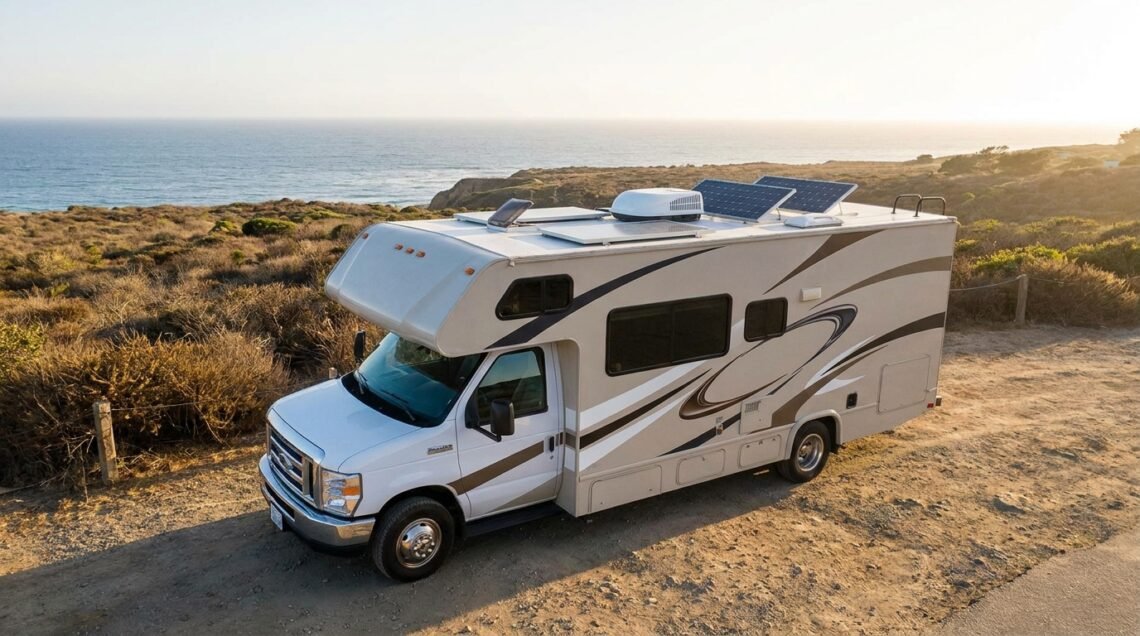
So, you’re wondering how many solar panels do you need for an RV? It’s a great question, and the straightforward answer is: it depends. There’s no single number that fits everyone because the ideal setup is a personal puzzle, pieced together based on how you use your RV and what you want to power.
Think of it like this: If you’re mostly boondocking off-grid for a few days at a time and just want to keep your lights on and charge your phones, you’ll need a very different system than someone who wants to run a full-size residential fridge, a TV, and air conditioning while parked in the middle of nowhere for weeks. We’ll break down the key factors that influence this decision, helping you build a system that truly works for your adventures.
This is the absolute bedrock of determining your solar panel count. If you skip this step, you’re essentially guessing, and that can be a costly mistake. You need to get a real handle on your daily energy consumption.
Table of Contents
The “Phantom Load” Drain
Even when your RV seems “off,” many appliances and devices are still sipping power. These are often called “phantom loads.” Think about your TV’s standby light, your refrigerator’s internal clock, smoke detectors, CO monitors, Wi-Fi boosters, and even USB chargers plugged into the wall – they all draw a little bit of current.
- How to Track: The best way to figure this out is by using a battery monitor. These devices connect to your battery bank and give you a real-time readout of how much power is going in and out. Leave it running for a few days while using your RV as you normally would, without any solar connected, and note the average amp-hours (Ah) you’re consuming daily.
Biggest Power Hogs in an RV
Some appliances are significantly more power-hungry than others. Identifying these will help you prioritize and understand where the biggest chunks of your energy budget are going.
Refrigeration
- Propane vs. Electric: If you have a propane fridge, its electrical draw is minimal – just enough to power the control board and ice maker if you have one. However, if you’ve upgraded to a residential-style DC or AC refrigerator, these can be massive power consumers, especially when running continuously.
- AC vs. DC Fridges: AC fridges require an inverter to run, which itself consumes power. DC fridges are generally more efficient for RV use as they run directly off your battery bank.
Entertainment Systems
- Televisions: While modern LED TVs are far more efficient than their older counterparts, they still add up, especially if you’re running them for extended periods.
- Audio Systems: High-end audio systems can draw a surprising amount of power, particularly if you like to crank it up.
Small Appliances and Gadgets
- Microwaves: These are energy vampires. While convenient, running a microwave for even a few minutes can significantly deplete your battery bank.
- Coffee Makers: Drip coffee makers, especially, require a good amount of power to heat water. Single-serve pod machines can also be intensive.
- Hair Dryers and Other Heating Appliances: Anything that uses a heating element (like hair dryers, toasters, electric kettles) is a major power draw and usually requires a substantial inverter and battery bank.
Charging Electronics
- Phones, Tablets, Laptops: These are generally low-draw items, but if you have multiple people in the RV and lots of devices to charge every day, it adds up.
- Actionable Tip: Make a list of every electrical device in your RV. Then, find its wattage (it’s usually on a label on the device). Estimate how many hours per day you use each item. Multiply wattage by hours, then divide by 12 (for 12-volt systems) to get your amp-hour consumption per day for each item. Sum them all up for your total daily requirement.
When considering how many solar panels you need for your RV, it’s also essential to think about where you plan to use them. For instance, if you’re considering boondocking in remote areas, you’ll want to ensure you have enough power to sustain your needs. A great resource for finding ideal locations for boondocking is this article on the 10 Best Boondocking Spots in the Southwest, which highlights some of the most scenic and accessible spots for RV enthusiasts.
How Much Sun Do You Actually Get? Site and Season Specifics
The most powerful solar panels are useless if they’re constantly shaded or if you’re using your RV in the dead of winter in the Pacific Northwest. Sunlight availability is a crucial piece of the puzzle.
Geographical Location Matters
- The Sun Belt Advantage: If you spend most of your time RVing in the sunny Southwest of the US, you’re going to get significantly more usable sunlight than someone who parks their RV in Alaska during December.
- Cloud Cover and Haze: Even in sunny areas, prolonged periods of cloud cover can drastically reduce your solar output.
Seasonal Variations
- Summer Highs: Longer days mean more hours of potential sun. Higher sun angles also mean panels are more directly facing the sun for longer periods.
- Winter Woes: Shorter days, lower sun angles, and often more cloud cover mean significantly less solar energy generation. If you plan to use your RV extensively off-grid in winter, you might need a much larger solar array or a significant supplemental charging strategy, like a generator.
Shading is the Enemy of Solar
- Trees: Campground shade is a common issue. Even a single tree branch strategically placed can significantly reduce the output of an entire panel, and therefore a whole array if panels are wired in series.
- Buildings and Other RVs: Parking next to taller buildings or even other large RVs can create shade, especially in the morning and late afternoon.
- Panel Placement: This is why careful consideration of where you mount your panels is so important. Fixed panels on the roof are convenient but can be subject to consistent shading.
- Actionable Tip: Research average daily peak sun hours for the regions and times of year you plan to RV. Online tools and resources exist that can give you this data. This is a critical factor in calculating how much power your panels can realistically generate. For instance, a 100-watt panel might produce 500 watt-hours in a location with 5 peak sun hours, but only 250 watt-hours in a location with 2.5 peak sun hours.
Battery Bank Size: The Unsung Hero
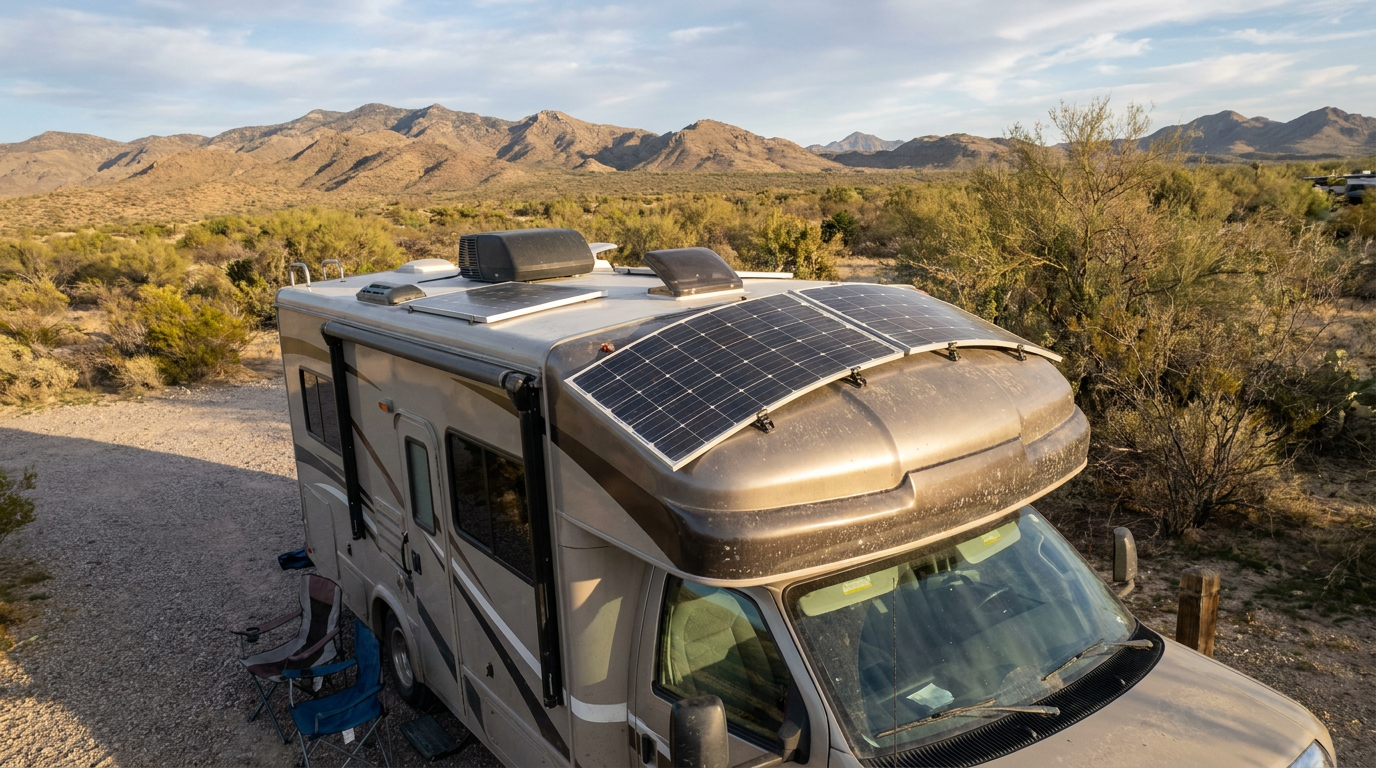
Your solar panels generate electricity, but your batteries store it. You can have the biggest solar array in the world, but if your battery bank can’t store the energy, it’s wasted. More importantly, if your battery bank is too small, you’ll constantly be running on fumes, which is bad for the battery’s health and can leave you without power.
Amp-Hours (Ah) as the Measure
- Understanding Ah: Battery capacity is typically measured in Amp-hours (Ah). This tells you how many amps a battery can deliver for a certain number of hours. A 100Ah battery could theoretically deliver 10 amps for 10 hours, or 5 amps for 20 hours.
- Depth of Discharge (DoD): This is crucial. You should never drain your batteries completely. For lead-acid batteries (like AGM or flooded), you ideally want to stay above 50% Depth of Discharge (DoD) to maximize their lifespan. Lithium batteries can handle much deeper discharge (80-100% DoD), but even for lithium, avoiding full discharge is generally a good practice.
Calculating Your Battery Needs
- Daily Consumption: Take your total daily amp-hour consumption (calculated in the first section).
- Recharge Time: Consider how many days you want to be able to run without any sun at all. This is your “buffer” or “autonomy.”
- Battery Type and DoD: Let’s say you consume 100Ah per day and want 2 days of autonomy, and you’re using AGM batteries where you only want to discharge to 50% (meaning you only use 50% of the battery’s capacity).
- Total required capacity = (Daily Consumption * Days of Autonomy) / Usable Capacity Percentage
- Total required capacity = (100 Ah * 2 days) / 0.50 = 400 Ah
- This means you’d need a battery bank with at least 400Ah of usable capacity. If you’re using lithium batteries and can discharge to 90%, the calculation would be: (100 Ah * 2 days) / 0.90 = 222 Ah. This highlights the significant advantage lithium batteries offer in terms of efficiency and lifespan.
The “Rule of Thumb” (and Why It’s Flawed)
Some sources might suggest a ratio of solar panel wattage to battery bank Ah. While these can give you a very rough starting point, they are often too generic. A 100Ah battery bank might be fine with 200 watts of solar if you only use 20Ah per day and have plenty of sun. But if you use 100Ah per day, you’ll need much more solar and a larger battery bank.
- Actionable Tip: Prioritize understanding your actual daily energy consumption and your desired battery autonomy. Then, factor in the chosen battery type and its safe DoD. Your battery bank size dictates how much energy you need your solar panels to replenish daily, not just how much you use.
Solar Panel Wattage Calculation: Putting It All Together
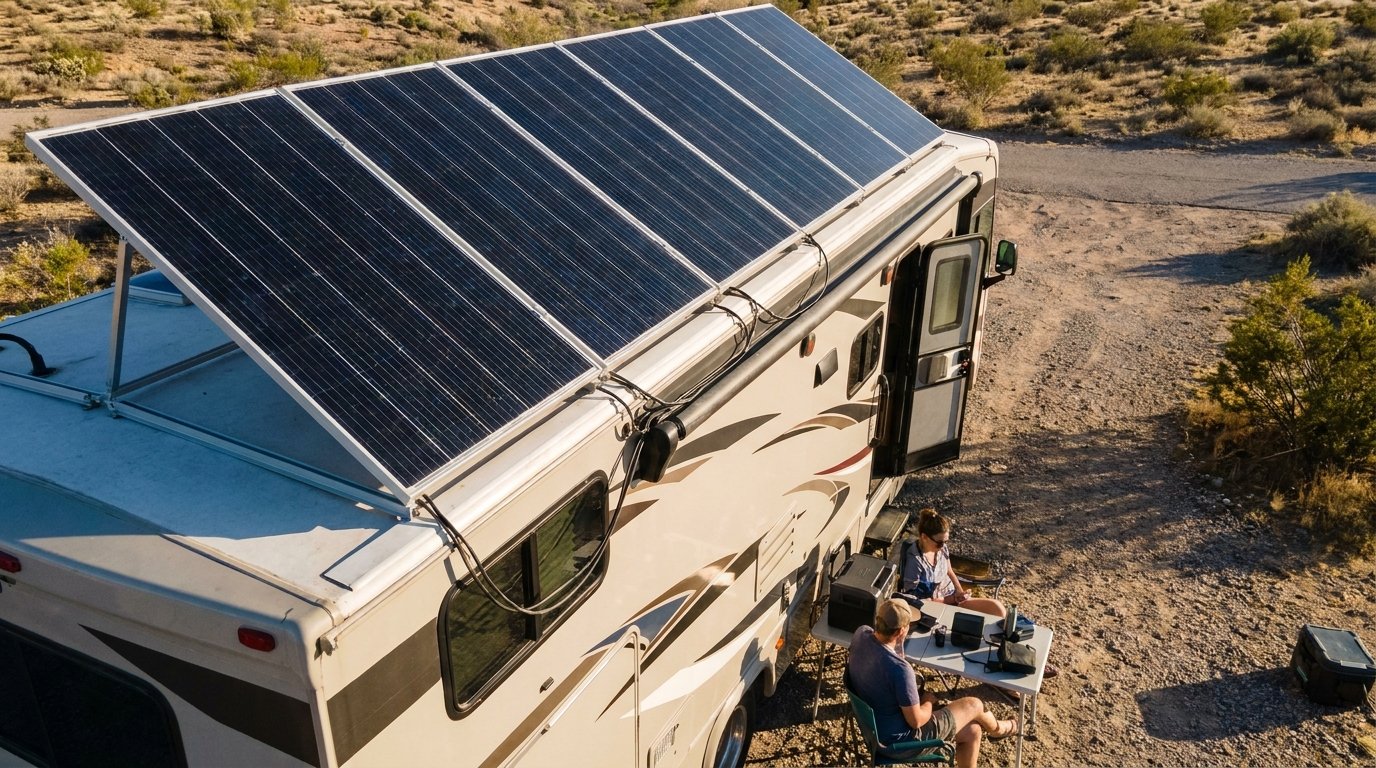
Now that you have a handle on your power needs and how much sun you can expect, we can start to calculate the solar panel wattage required. This is where the math starts to get practical.
The Basic Formula
The core idea is to generate enough power each day to replenish what you’ve used, while accounting for the efficiency losses and the available sunlight.
- Daily Energy Needed (Watt-hours): Your daily amp-hour consumption multiplied by your battery voltage (typically 12V for RVs). So, 100 Ah * 12V = 1200 Watt-hours (Wh) per day.
- Usable Sunlight Hours: This is the average number of “peak sun hours” you get in your typical RVing location and season. Let’s say 4 peak sun hours for this example.
- System Losses: You lose power due to resistance in wires, the charge controller’s efficiency, and the battery’s charging efficiency. A reasonable estimate for total system losses is around 20-30%. Let’s use 25% for our calculation (meaning your system is only 75% efficient).
The Calculation
Here’s how it breaks down:
- Total Energy to Generate (factoring in losses):
- Daily Energy Needed / System Efficiency = Total Energy to Generate
- 1200 Wh / 0.75 = 1600 Wh
- Required Solar Panel Wattage:
- Total Energy to Generate / Usable Sunlight Hours = Required Panel Wattage
- 1600 Wh / 4 hours = 400 Watts
So, in this scenario, you would theoretically need about 400 watts of solar panels.
Refinements and Considerations
- Undersizing vs. Oversizing: It’s almost always better to slightly oversize your solar array than to undersize it. Having a little extra capacity means you’ll charge your batteries faster on sunny days, and you’ll have a better chance of fully replenishing your batteries on days with less-than-ideal sun.
- Types of Panels: The wattage rating on a solar panel is its peak output under ideal laboratory conditions. Real-world conditions will always be less. Monocrystalline panels are generally more efficient than polycrystalline panels, meaning they can produce more power from the same amount of space.
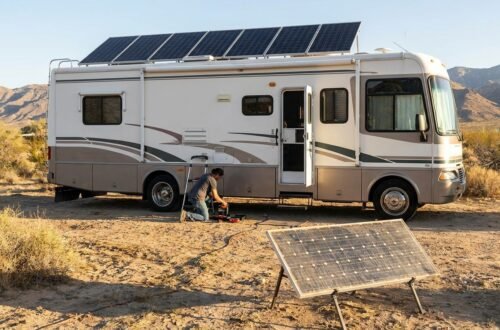
- Fixed vs. Portable Panels: Fixed roof-mounted panels are convenient but can be subject to shading. Portable panels can be moved to chase the sun or avoid shade, but require setup and takedown.
- Actionable Tip: Start with the basic calculation. Then, add a buffer of 10-20% to your calculated wattage. This buffer accounts for unexpected cloudy days, aging panels, and gives you a bit more breathing room.
When considering how many solar panels you need for an RV, it’s also important to think about where you’ll be camping and how you’ll find those ideal spots. For instance, utilizing the right apps can significantly enhance your boondocking experience by helping you locate free campsites. You can explore more about this in the article on the best boondocking apps, which provides valuable insights for RV enthusiasts looking to maximize their adventures. Check it out here.
Panel Quantity vs. Panel Wattage: What’s the Difference?
| RV Size | Energy Consumption (kWh/day) | Number of Solar Panels Needed |
|---|---|---|
| Small (20-25 feet) | 10-15 | 2-3 |
| Medium (25-30 feet) | 15-20 | 3-4 |
| Large (30+ feet) | 20-25 | 4-5 |
This is where people sometimes get confused. The question is “how many panels?” but the real determining factor is the total wattage of those panels.
Wattage is King
- Individual Panel Ratings: Solar panels come in various wattages, commonly 100W, 175W, 200W, etc. A 200W panel will produce roughly twice the power of a 100W panel under the same conditions, assuming similar efficiency.
- System Capacity: If your calculation determined you need 400 watts of solar, you could achieve this with:
- Four 100-watt panels
- Two 200-watt panels
- One 400-watt panel (less common for RVs due to size)
- A combination of different wattage panels
Mounting Space and Weight
- Roof Real Estate: The biggest constraint for many RVers is the physical space available on their roof. This is where choosing higher-wattage panels might become more practical if you have limited square footage.
- Weight Concerns: While solar panels themselves aren’t excessively heavy, a large array can add up. You need to be mindful of your RV’s roof load capacity.
How Many Solar Panels Do You Need For An RV?
When you see an RV with “two solar panels,” it usually means two panels of a certain wattage (often 100W or 200W). The total wattage is what truly matters for power generation. Two 200W panels give you 400W, which is the same total output as four 100W panels.
- Efficiency vs. Quantity: Sometimes, using fewer, higher-wattage panels can be more efficient if they are of a higher quality and efficiency class. They might also simplify wiring.
- Wiring Considerations: The way panels are wired (series vs. parallel) affects the voltage and amperage of the system, which needs to be compatible with your charge controller. This is a technical aspect, but it highlights why the total wattage is the primary goal, and the number of panels is a means to achieve that goal within your constraints.
- Actionable Tip: Focus on your calculated total required wattage. Then, look at the available space on your RV roof and the individual panel wattages that fit your budget and space. The number of panels will naturally be determined by these factors.
Real-World Scenarios: Examples to Guide You
Let’s put some of this into practice with a few common RVing scenarios. These are illustrative examples and will still require you to do your own specific calculations.
Scenario 1: The Weekend Warrior (Light Usage)
- Usage: Primarily uses RV for weekend trips, rarely boondocks. Powers lights, charges phones/tablets once or twice. Has a propane fridge. No microwave or high-draw appliances.
- Estimated Daily Consumption: Low, maybe 30-50Ah.
- Battery Bank: A single 100-120Ah AGM battery might suffice.
- Sunlight: Mostly parks in established campgrounds with good sun exposure on weekends.
- Solar Calculation (Example):
- Daily Consumption: 40Ah
- Battery Voltage: 12V
- Daily Energy Needed: 40Ah * 12V = 480Wh
- Usable Sunlight: Let’s assume 4 hours
- System Efficiency: 75%
- Total Energy to Generate: 480Wh / 0.75 = 640Wh
- Required Panel Wattage: 640Wh / 4 hours = 160W
- Recommendation: A single 200-watt solar panel would be an excellent, robust choice. It would easily keep the battery topped up and provide a good buffer. You could even get away with a 100W panel if you were extremely conservative with power.
Scenario 2: The Off-Grid Enthusiast (Moderate Usage)
- Usage: Spends several days at a time boondocking. Runs lights, charges multiple devices daily, uses a residential-style DC fridge, might run a small TV. Has a propane stove but uses an electric kettle or small microwave occasionally.
- Estimated Daily Consumption: 80-150Ah, depending on fridge efficiency and appliance use.
- Battery Bank: Needs a larger bank, perhaps 200-300Ah of AGM or 150-200Ah of lithium.
- Sunlight: Varies, so needs a robust system that can charge quickly on sunny days.
- Solar Calculation (Example):
- Daily Consumption: 120Ah
- Battery Voltage: 12V
- Daily Energy Needed: 120Ah * 12V = 1440Wh
- Usable Sunlight: Let’s assume 4 hours
- System Efficiency: 75%
- Total Energy to Generate: 1440Wh / 0.75 = 1920Wh
- Required Panel Wattage: 1920Wh / 4 hours = 480W
- Recommendation: A system of 400-600 watts would be ideal. This could be two 200W panels, three 200W panels, or four 150W panels. This provides a good margin for charging and keeping the fridge running.
Scenario 3: The Full-Timer with Luxuries (Heavy Usage)
- Usage: Lives in the RV full-time, primarily boondocking. Runs multiple devices, a high-wattage residential fridge/freezer, multiple TVs, laptops, potentially even a small inverter AC unit or an induction cooktop occasionally.
- Estimated Daily Consumption: 200Ah+, can easily go higher.
- Battery Bank: Requires a substantial battery bank, likely 400Ah+ of lithium for deep cycle capability and weight efficiency.
- Sunlight: Needs to maximize charging whenever sun is available.
- Solar Calculation (Example):
- Daily Consumption: 250Ah
- Battery Voltage: 12V
- Daily Energy Needed: 250Ah * 12V = 3000Wh
- Usable Sunlight: Let’s say a modest 3.5 hours due to potential shading or winter use
- System Efficiency: 75%
- Total Energy to Generate: 3000Wh / 0.75 = 4000Wh
- Required Panel Wattage: 4000Wh / 3.5 hours = ~1140W
- Recommendation: This scenario screams for a large solar array, likely 800-1200 watts or more. This might involve six 200W panels, or even more. Installation of such large systems also requires careful consideration of roof space, wiring, and potentially higher-rated charge controllers (like MPPT controllers capable of handling higher input voltages). For power-hungry items like AC units, a generator or shore power will almost certainly be necessary supplemental sources.
- Actionable Tip: Use these scenarios as a starting point. Log your own power usage meticulously for at least 3-5 days, paying attention to everything you run. Then, plug those numbers into the calculations, consider your typical locations, and err on the side of more solar if space and budget allow.
By systematically working through your power needs, understanding your environment, and performing these calculations, you can move beyond generic advice and determine the right number of solar panels to power your RV adventures. It’s a bit of homework, but it leads to a much more reliable and enjoyable off-grid experience.
FAQs
1. What factors determine the number of solar panels needed for an RV?
Factors such as the energy consumption of the RV appliances, the size of the RV’s battery bank, the available roof space for solar panels, and the amount of sunlight in the area where the RV will be used all play a role in determining the number of solar panels needed.
2. How can I calculate the number of solar panels needed for my RV?
To calculate the number of solar panels needed, you can start by determining your daily energy consumption, then consider the average daily sunlight hours in your location, and finally, calculate the total wattage of solar panels needed to meet your energy needs.
3. What is the average number of solar panels needed for an RV?
The average number of solar panels needed for an RV can vary depending on the factors mentioned earlier, but a common range is between 2 to 4 solar panels, each with a wattage of around 100 to 300 watts.
4. Can I install more solar panels than necessary on my RV?
Yes, you can install more solar panels than necessary to have a surplus of energy production, which can be beneficial during periods of low sunlight or increased energy consumption.
5. Are there any limitations to the number of solar panels that can be installed on an RV?
The limitations to the number of solar panels that can be installed on an RV are primarily related to the available roof space for installation and the weight capacity of the RV’s roof. It’s important to consider these limitations when determining the number of solar panels for your RV.


2 Comments on “How Many Solar Panels Do You Need For An RV?”