

When you’re looking on how to wire RV batteries, you might come across terms like “series” and “parallel” when people talk about wiring batteries. The core idea is pretty straightforward: series wiring jacks up the voltage while keeping the amp-hour (Ah) capacity the same, whereas parallel wiring boosts the amp-hour capacity while leaving the voltage unchanged. Knowing which one to use, or even how to combine them, makes a big difference in how long your lights stay on, how well your appliances run, and ultimately, how enjoyable your time off the beaten path is.
Table of Contents
Why Bother With Battery Wiring?
You’ve probably got a battery (or maybe a couple) in your RV already. They do the basic job of powering things when you’re not plugged into shore power. But as RVs get more complex, with bigger fridges, more entertainment devices, and fancier electronics, those standard batteries sometimes just don’t cut it. That’s where understanding series and parallel wiring comes in. It’s about making your existing battery bank work harder, and making sure you have the juice to power everything you need, when you need it.
It’s not just about having more power; it’s about having the right kind of power. Do you need a higher voltage to push power through a long wire run, or do you just need your lights to stay on for an extra day? Your answer dictates how you’ll wire those batteries.
When considering how to wire RV batteries in series vs. parallel, it’s essential to understand the implications of each method on your power system’s voltage and capacity. For a deeper dive into this topic, you may find the article on RV battery configurations helpful, as it explains the advantages and disadvantages of both wiring methods. To learn more, visit this informative article that provides insights into optimizing your RV’s electrical setup.
Series Wiring: Upping the Voltage
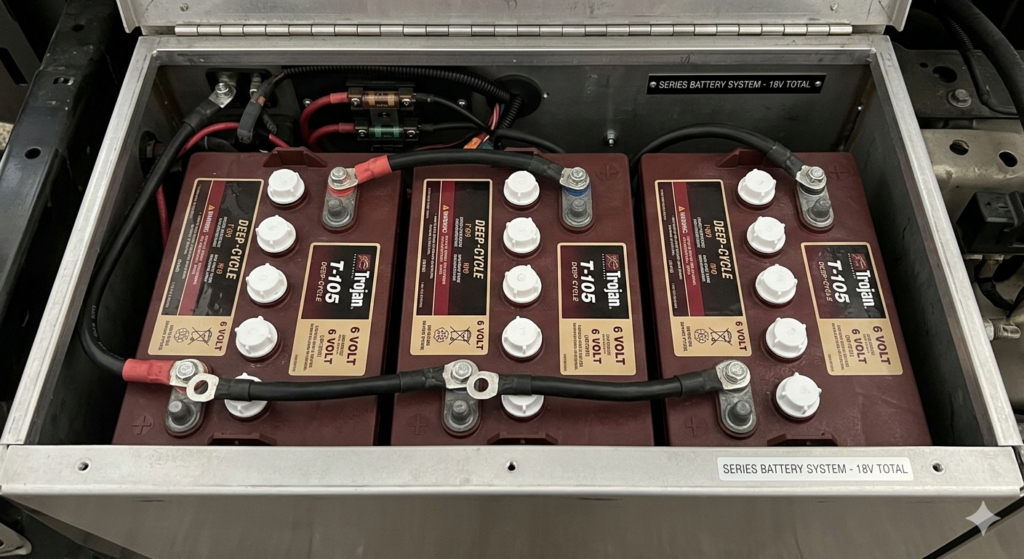
Think of series wiring like stacking batteries in a line, one after the other. You connect the negative terminal of one battery to the positive terminal of the next. This essentially forces the electricity to flow through each battery in sequence, adding up their voltages.
How It Works in Practice
Let’s say you have three 12-volt (V), 100 amp-hour (Ah) batteries. If you wire them in series, you’re not getting 300 Ah. Instead, you’re end up with 36V (12V + 12V + 12V = 36V) but still only 100 Ah. This is a significant boost in voltage.
- Example: Imagine your RV has a specific appliance that needs 36V to run efficiently. Wiring three 12V batteries in series is the way to achieve that. You’re not getting more “storage” in terms of how long things can run at their normal power draw, but you’re getting a higher “push” of electricity.
What’s the Payoff?
Why would you want higher voltage?
- Reduced Current: Higher voltage means less current (amps) is needed to deliver the same amount of power (watts = volts x amps). This is a big deal because thinner, cheaper, and lighter wires can be used. Less current also means less heat generated in the wires, reducing the risk of power loss and potential fire hazards. For example, if you need to power a device that draws 1000 watts, at 12V that’s about 83 amps. At 36V, it’s only about 28 amps. That’s a huge difference in cable size and efficiency.
- Efficiency Boost: In some applications, higher voltage operation can simply be more efficient. This is why you see higher voltage systems in things like electric golf carts or larger trolling motors that need a strong initial surge of power.
The Downsides to Consider
It’s not all sunshine and higher voltage, though.
- One Weak Link: The biggest drawback is that if one battery in the series has an issue – maybe it’s older, damaged, or just not fully charged – it can cripple the entire system. It becomes the bottleneck, and the whole bank’s performance suffers.
- Identical Twins Required: You absolutely must use identical batteries when wiring in series. This means they should be the same brand, same model, same age, and ideally from the same batch. Mixing batteries with different capacities, internal resistances, or states of charge will lead to uneven charging and discharging, significantly shortening their lifespan and causing performance problems.
- Complex Monitoring: Keeping track of the health of individual batteries in a series bank can be more complicated. You often need specialized battery monitors that can track voltage and current to each battery to ensure they’re all playing nicely together. Voltage balancing is crucial to prevent one battery from being overcharged or over-discharged relative to the others.
Parallel Wiring: Extending Your Runtime
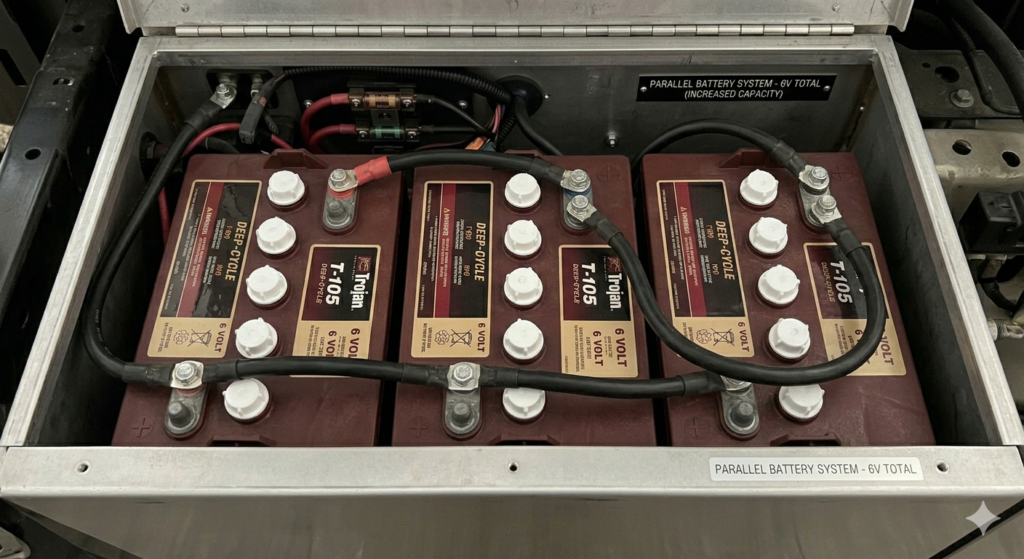
Parallel wiring is the opposite of series. Instead of stacking them end-to-end, you’re lining them up side-by-side. You connect all the positive terminals together and all the negative terminals together. This configuration allows the electricity to flow through all batteries simultaneously, effectively increasing your total amp-hour capacity.
How It Works in Practice
Let’s go back to our 12V, 100Ah batteries. If you wire two of them in parallel, you don’t get 24V. What you get is 12V (the voltage stays the same) but a doubled capacity of 200Ah (100Ah + 100Ah = 200Ah).
- Example: This is the standard setup for most RVs. You want to run your fridge, lights, and maybe charge your laptops for as long as possible when you’re not hooked up. Doubling your Ah capacity means you effectively double the “fuel tank” for your electrical system, letting you stay off the grid for longer.
What’s the Payoff?
Parallel wiring brings a different set of advantages:
- Extended Runtime: This is the primary benefit. More Ah means more stored energy, translating directly into longer periods of use between charges. This is crucial for boondockers or anyone who wants to minimize their reliance on campgrounds with hookups.
- Redundancy and Reliability: If one battery in a parallel bank fails, the others can usually keep running. The system won’t suddenly die on you. You’ll experience a reduction in your total Ah capacity, but the entire electrical system usually stays operational, giving you time to assess and fix the problem. This is a huge safety and convenience feature.
- Simpler Charging: Charging batteries in parallel is generally more straightforward than with series setups. Most standard RV chargers are designed to work with 12V systems.
- Easier Maintenance: While you still need to check connections and electrolyte levels (if applicable), managing the health of individual batteries in a parallel bank can be less complex than a series arrangement.
The Downsides to Consider
Like series wiring, parallel has its trade-offs:
- Thicker Cables Required: Because you’re combining the current from multiple batteries, the total current flowing through the connecting cables can be very high. To handle this safely and efficiently, you need much thicker, heavier, and more expensive battery cables. Undersized cables can overheat, leading to power loss and a serious fire risk.
- Voltage Balancing is Crucial: Before connecting batteries in parallel, they MUST be at the same voltage. If you connect a fully charged battery to a nearly dead one, the charged battery will try to rapidly charge the dead one, potentially causing damage to both. This is why it’s highly recommended to have all batteries at the same state of charge before connecting them.
- Risk of Uneven Wear: While redundant, there’s still a risk of uneven wear if batteries aren’t perfectly matched. One battery might end up doing a slightly larger share of the work, leading to it degrading faster than the others. Regular checks and maintenance are key here.
The Series-Parallel Hybrid: The Best of Both Worlds?
So far, we’ve looked at pure series or pure parallel. But what if you need both higher voltage and more capacity? That’s where a series-parallel hybrid setup comes in. This is like building a larger battery bank by first creating smaller series banks and then wiring those banks in parallel.
How It Works in Practice
Let’s say you want a 24V system with a total of 400Ah. You could take four 12V, 200Ah batteries.
- Step 1 (Series): Wire two 12V, 200Ah batteries in series to create a 24V, 200Ah “sub-bank.”
- Step 2 (Series Again): Wire the other two 12V, 200Ah batteries in series to create a second 24V, 200Ah sub-bank.
- Step 3 (Parallel): Now, wire these two 24V, 200Ah sub-banks in parallel. You’ll connect the positive terminals of both sub-banks together and the negative terminals of both sub-banks together.
The result? You end up with a 24V system that has 400Ah of capacity (200Ah from the first sub-bank + 200Ah from the second sub-bank).
When is This Useful?
This hybrid approach is exceptionally useful for larger RVs or boats that have systems designed to run on 24V or even 48V, but also need a substantial amount of energy storage for extended trips. For example, upgrading a large fifth-wheel to a 48V system can significantly reduce the size and weight of the high-voltage wiring needed for powerful inverters and other high-draw appliances, while still providing ample runtime.
When considering the best way to wire RV batteries, understanding the differences between series and parallel configurations is crucial for optimizing your power system. For those looking to dive deeper into this topic, you might find the related article on RV battery setups particularly helpful. It provides insights into the advantages and disadvantages of each method, ensuring you make an informed decision. You can read more about it in this detailed guide that covers various aspects of RV battery management.
Practical Considerations and Safety First
No matter which configuration you choose, there are some universal truths to keep in mind.
- Battery Type Matters: The type of battery (lead-acid, AGM, gel, lithium-ion) can influence how you wire and manage your bank. Lithium batteries, especially, are more tolerant of deeper discharge and have different charging profiles, which might slightly alter recommendations for battery balancing. However, the core principles of series and parallel wiring remain the same.
- Identical Batteries are Key (Again): I cannot stress this enough. For ANY configuration, but especially series and hybrid, using batteries that are identical in every way is paramount for longevity and performance. Mixing brands, ages, or capacities is a recipe for disaster.
- Proper Connections: Using high-quality, properly sized connectors and ensuring all connections are clean and tight is critical. Loose connections are a major source of resistance, heat, and potential failure.
- Fusing and Protection: Always install appropriate fuses or circuit breakers between your battery bank and your loads, and between any parallel connections, to protect against short circuits. This is a critical safety measure that shouldn’t be skipped. If you’re wiring multiple batteries in parallel, each connection to the main bus bar should ideally have its own fuse.
- Ventilation: If you’re using flooded lead-acid batteries, ensure proper ventilation for the gases they produce during charging. AGM and gel batteries are sealed and don’t have this issue, and lithium batteries are also sealed and produce no gasses.
- Know Your Limits: For DIY setups, keeping the number of batteries in parallel to a manageable number, typically 4-8, will make management easier. While series connections don’t have a theoretical limit on voltage, most practical RV systems cap out at 48V for safety and compatibility with available equipment. Going higher often requires specialized knowledge and equipment.
Getting It Right for Your RV
Ultimately, the best wiring configuration for your RV depends entirely on your specific needs.
- For Maximum Runtime at 12V: If your RV’s electrical system is 12V and you just want to stay powered longer, you’ll most likely be adding batteries in parallel. This is the most common upgrade for boondocking.
- For Higher Voltage Applications: If you have specific 24V or 36V appliances, or a system designed for higher voltage, you’ll need series wiring (or a hybrid) to achieve that required voltage.
- For the Ultimate Powerhouse: Large, custom RVs with high-power inverters and demanding appliances might benefit from a series-parallel hybrid setup to get both high voltage and massive capacity.
Before you grab your wrench, take some time to assess what you’re trying to achieve and your current RV’s electrical system. If you’re unsure, consulting with an RV technician or an experienced mobile electronics specialist is always a wise move. Getting your battery bank wired correctly is fundamental to a reliable and enjoyable RV experience.
FAQs
What is the difference between wiring RV batteries in series vs parallel?
When wiring RV batteries in series, the positive terminal of one battery is connected to the negative terminal of the next, increasing the voltage. In parallel wiring, the positive terminals are connected together and the negative terminals are connected together, increasing the capacity.
What are the advantages of wiring RV batteries in series?
Wiring RV batteries in series increases the voltage, which can be beneficial for powering high-voltage appliances or equipment in the RV. It also allows for a longer runtime before needing to recharge the batteries.
What are the advantages of wiring RV batteries in parallel?
Wiring RV batteries in parallel increases the capacity, providing more power for running multiple appliances or equipment simultaneously. It also allows for a longer overall lifespan of the battery bank.
What are the potential drawbacks of wiring RV batteries in series?
One potential drawback of wiring RV batteries in series is that if one battery in the series fails, it can affect the entire circuit and cause a complete power loss. Additionally, the increased voltage may not be suitable for all RV appliances and equipment.
What are the potential drawbacks of wiring RV batteries in parallel?
One potential drawback of wiring RV batteries in parallel is that if one battery in the parallel circuit fails, it can still draw power from the other batteries, potentially causing damage. Additionally, the increased capacity may lead to longer charging times and may require a larger charging system.





One comment on “Discover How to Wire RV Batteries in Series vs Parallel Without Killing Your Bank”